
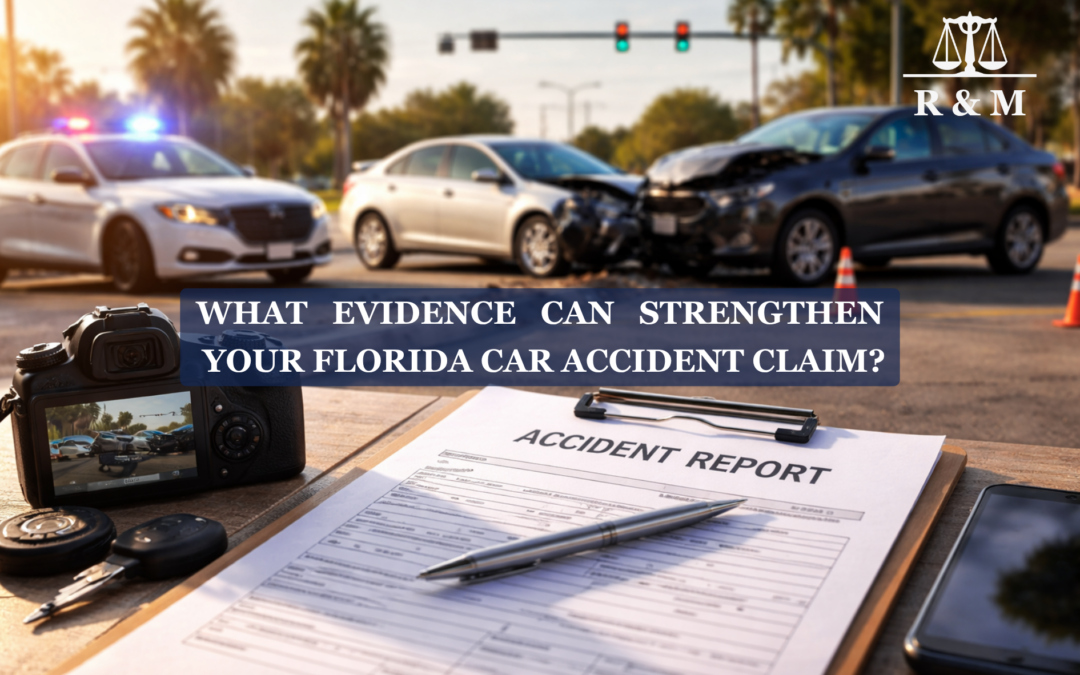
After a car accident, many people assume that telling their side of the story is enough. However, Florida car accident evidence plays a central role in determining how claims are evaluated and resolved.
In reality, personal injury claims depend on what can be proven, documented, and supported. Because of this, understanding what evidence matters can significantly impact the outcome of your case.
Why Florida Car Accident Evidence Matters
Insurance companies and courts rely on evidence to determine:
-
How the accident occurred
-
Who was at fault
-
The extent of injuries and damages
-
Whether compensation is justified
Without strong evidence, even valid claims can face delays, disputes, or reduced value.
Accident Scene Evidence That Can Support Your Claim
First, evidence from the accident scene often helps establish how the crash occurred.
Helpful accident scene evidence may include:
-
Photographs or videos of vehicle damage
-
Images of skid marks, debris, and road conditions
-
Traffic signals, signage, or obstructions
-
Dashcam or nearby surveillance footage
When you gather this information early, it becomes much easier to reconstruct the events of the accident.
Police Reports and Official Documentation
Next, a police crash report can provide important details that support your claim.
These reports often include:
-
Date, time, and location of the accident
-
Involved parties and witness information
-
Preliminary observations about fault
-
Citations issued at the scene
Although police reports do not always determine fault on their own, they often influence how insurance companies evaluate claims.
Medical Records and Injury Documentation
Equally important, medical records connect your injuries directly to the accident.
Strong medical documentation may include:
-
Emergency room or urgent care records
-
Follow-up treatment notes
-
Diagnostic imaging such as X-rays or MRIs
-
Physician statements regarding injury severity
If treatment is delayed or inconsistent, insurance companies may question whether the injuries resulted from the accident.
Witness Statements and Independent Accounts
In addition, witness statements can provide valuable third-party perspectives.
Witness evidence may include:
-
Descriptions of how the accident occurred
-
Observations of unsafe driving or traffic violations
-
Confirmation of key details in your account
Because witnesses are independent, their statements often carry significant weight when fault is disputed.
Digital and Electronic Evidence
Today, many accidents involve digital evidence that can strengthen a claim.
For example:
-
Dashcam recordings
-
Traffic camera footage
-
Cell phone data related to distracted driving
-
Vehicle data from onboard systems
Since this type of evidence can disappear quickly, preserving it early is often critical.
How Florida Car Accident Evidence Is Evaluated
Not all evidence carries the same weight. Insurance companies often analyze evidence closely and may attempt to:
-
Question credibility or reliability
-
Downplay certain records
-
Dispute causation or injury severity
As a result, the way evidence is collected and presented can influence the direction of a claim.
Why Early Action Helps Preserve Evidence
Over time, important evidence can disappear. Vehicles are repaired, footage may be overwritten, and memories can fade.
For this reason, early action can help:
-
Identify what evidence matters most
-
Preserve time-sensitive records
-
Avoid documentation mistakes
-
Strengthen the overall claim
Taking the right steps early can make a meaningful difference later.
Strong Evidence Can Make a Meaningful Difference
Every car accident case is different. However, strong documentation and clear evidence often shape how claims are resolved.
If you are dealing with the aftermath of an accident, understanding how Florida car accident evidence works can help you protect your rights and make informed decisions.
For more information, explore the Rosenblum & Mayer blog or contact our office to discuss your situation.